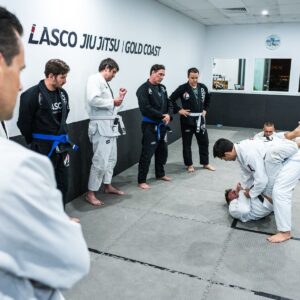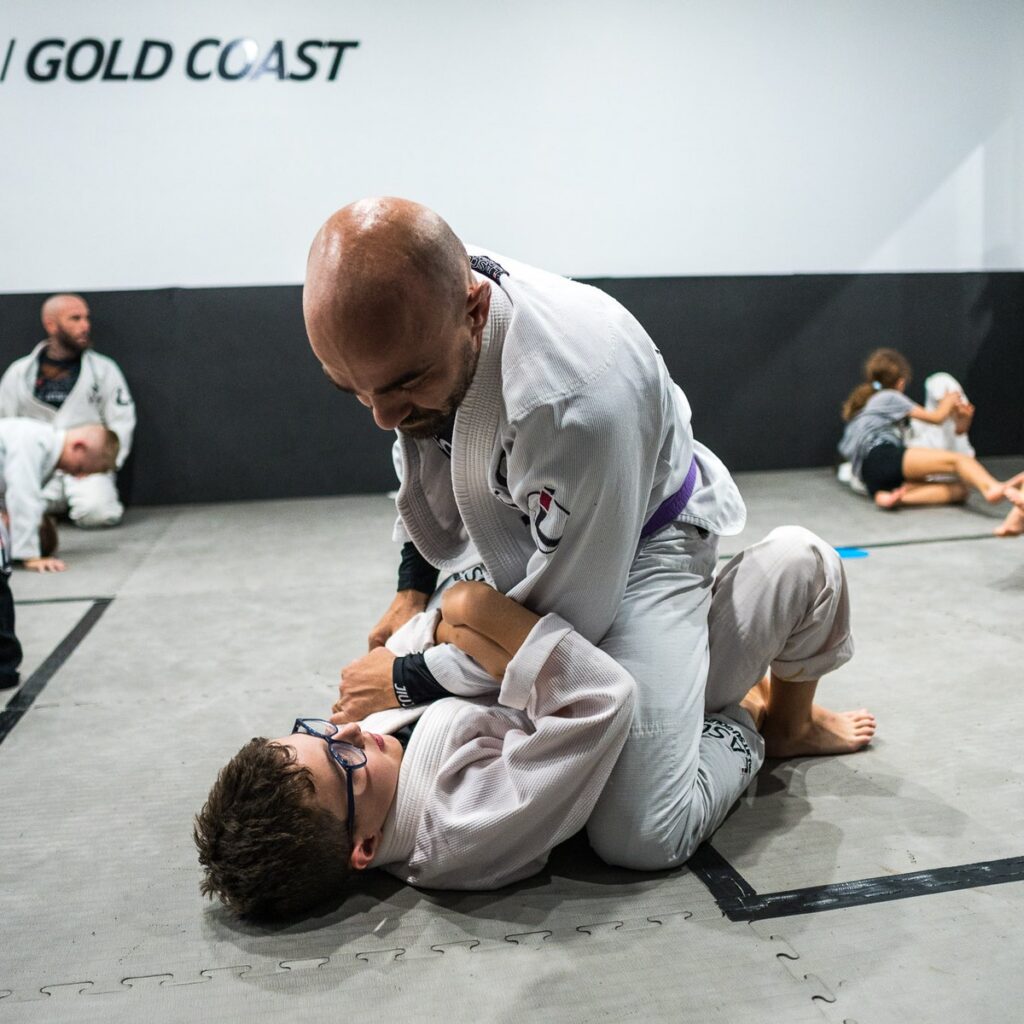
Yes—parents and children can train Brazilian Jiu Jitsu at the same academy while following programmes designed for their age and stage. For families looking for family BJJ on the Gold Coast, this can make training easier to organise and gives everyone a shared activity, without expecting a three-year-old, a teenager and an adult beginner to learn in the same way.
At Lasco Jiu Jitsu in Varsity Lakes, families from Robina, Burleigh Heads and Reedy Creek can explore adult and children’s programmes in one welcoming academy. The key is choosing the right class for each family member, checking the current timetable and allowing everyone to progress at an appropriate pace.
What does family BJJ actually mean?
Family BJJ does not necessarily mean that every member of the household takes the same class. It means the academy can support different ages and experience levels under one roof, with a consistent culture of respect, learning and community.
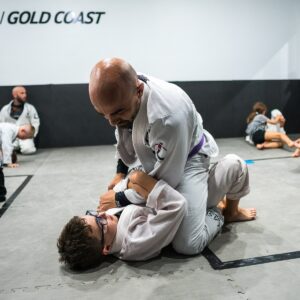
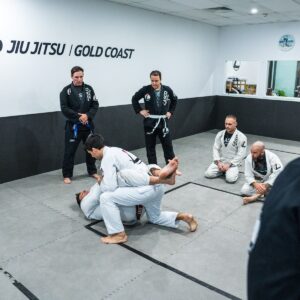
A parent might attend an adult Gi or No-Gi session, while a child joins an age-specific programme. Younger children can build comfort with movement and listening skills, while older children and adults can work on technique, positional understanding and controlled practice suited to their group.
For local families, training at one academy also creates a common language. Conversations at home can move beyond “How was class?” to more specific questions: What did you learn? What was difficult? How did you solve the problem? That shared interest can help children feel that their effort matters, even when the parent and child are on different learning paths.
How Lasco separates classes by age
Children learn best when coaching, activities and expectations match their developmental stage. Lasco’s BJJ programmes in Varsity Lakes are divided into age groups rather than placing every child into one broad kids class.
- Parents & Me: ages 3–4, with a parent or guardian participating alongside the child.
- Kids: ages 5–7.
- Juniors: ages 8–10.
- Teens: ages 11–13.
Adults have their own training options, including Gi and No-Gi. This structure lets coaches present skills in a way that makes sense for each group and gives students an environment where they can learn with people at a similar stage.
Always check the current Lasco class timetable before planning your week, as it is the best source for the latest class days and times.
Why parents and children often enjoy training at the same academy
A shared routine without identical expectations
BJJ can become part of the family rhythm. Everyone understands that progress comes from arriving, paying attention, practising and returning consistently. However, a good family routine still leaves room for different motivations. One person may enjoy technical problem-solving, another may want a social activity, and another may simply love moving and learning new skills.
Keeping those motivations separate prevents healthy encouragement from becoming pressure. A child does not need to progress at the same speed as a sibling, and a parent does not have to be an expert to support the child’s experience.
Parents can model being a beginner
Children often see adults in situations where the adult already knows what to do. Starting BJJ gives parents a chance to model something different: listening carefully, asking questions, making mistakes and trying again.
That can be a useful lesson in itself. When a child sees that adults also need patience and repetition, being new feels less uncomfortable. The focus shifts from getting everything right immediately to improving through practice.
A stronger connection to the academy community
When more than one family member trains, the academy can feel less like a drop-off activity and more like a shared community. Parents become familiar with the environment and the values being reinforced on the mats. Children see adults treating coaches and training partners with respect.
Community matters because consistency is easier when people feel comfortable walking through the door. Lasco serves families in Varsity Lakes and nearby Gold Coast suburbs, including Robina, Burleigh Heads and Reedy Creek, so the academy can be a practical local option as well as a place to train.
Can a parent and young child train together?
For children aged 3–4, the Parents & Me programme is the clearest example of training together. A parent or guardian participates with the child in an age-appropriate introduction to Brazilian Jiu Jitsu.
At this age, the goal is not to treat small children like miniature adults. Young students benefit from simple instructions, playful movement and a supportive environment. Parent participation can help a child feel secure while learning how to follow directions, move safely and engage with the group.
For older children, the best fit is usually their own age-specific class. Parents can still be involved by supporting attendance, showing interest and, if they choose, training in the adult programme.
How to start BJJ as a family
- Talk about individual goals. Ask what each person hopes to enjoy or learn. Keep the conversation open rather than deciding that everyone must want the same outcome.
- Choose the correct programme. Use age and experience as the starting point. If you are unsure, contact the academy before attending.
- Review the timetable. Compare the schedule with school, work and other commitments. A routine that is realistic is more valuable than an ambitious plan that cannot be maintained.
- Prepare for the first visit. Wear comfortable training clothes and arrive ready to listen. The academy can advise you about the appropriate uniform for the session.
- Let progress look different. Adults and children will face different challenges. Celebrate effort, confidence and consistency rather than comparing techniques or speed of improvement.
If your child is hesitant, it may help to read about how Brazilian Jiu Jitsu can support confidence in children. You can also explore the Lasco BJJ blog for practical guidance for beginners and families.
What should families look for in a BJJ academy?
Start with the learning environment. Children and adult beginners should be able to ask questions without feeling embarrassed. Coaching should be clear, training should be controlled, and students should understand that respect for partners is part of every session.
Age grouping is also important. A preschool child, a primary-school student and a teenager have different physical, emotional and attention needs. A programme that recognises those differences is better positioned to make instruction understandable and engaging.
Finally, consider whether the academy is realistic for family life. Location, timetable and communication all affect whether training becomes a sustainable routine. For families near Varsity Lakes, Robina, Burleigh Heads or Reedy Creek, choosing a nearby academy can reduce friction and make it easier to attend consistently.
Frequently asked questions
Do parents and children have to train in the same class?
No. Family BJJ usually means that different members can train at the same academy in classes suited to their age and experience. The Parents & Me programme is specifically designed for a parent or guardian to participate with a child aged 3–4.
Can complete beginners join as a family?
Yes. Prior BJJ experience is not required to enquire about beginner-friendly options. Each person should join the programme that matches their age and level.
What ages are covered by the children’s programmes?
Lasco lists Parents & Me for ages 3–4, Kids for ages 5–7, Juniors for ages 8–10 and Teens for ages 11–13.
Is there adult Gi and No-Gi training?
Yes. Lasco’s adult programme includes Gi and No-Gi training. Check the current timetable for session availability.
How do we find the right starting class?
Review the timetable and contact Lasco with the ages and experience levels of the family members who want to train. The team can help you identify the most suitable option.
Ready to explore family BJJ on the Gold Coast?
Lasco Jiu Jitsu welcomes adults and children at its Varsity Lakes academy, serving families from across the surrounding Gold Coast area. If you would like help choosing the right programme for your family, speak with the team before your first visit.